The first time I came across the idea of people causing their own environmental collapse was as a teenager, reading about Easter Island. The story went that the islanders’ obsession with their giant stone statues led them to cut down their forests, and that their society collapsed as a result. Archaeologists have since challenged that story, but the idea stayed with me.
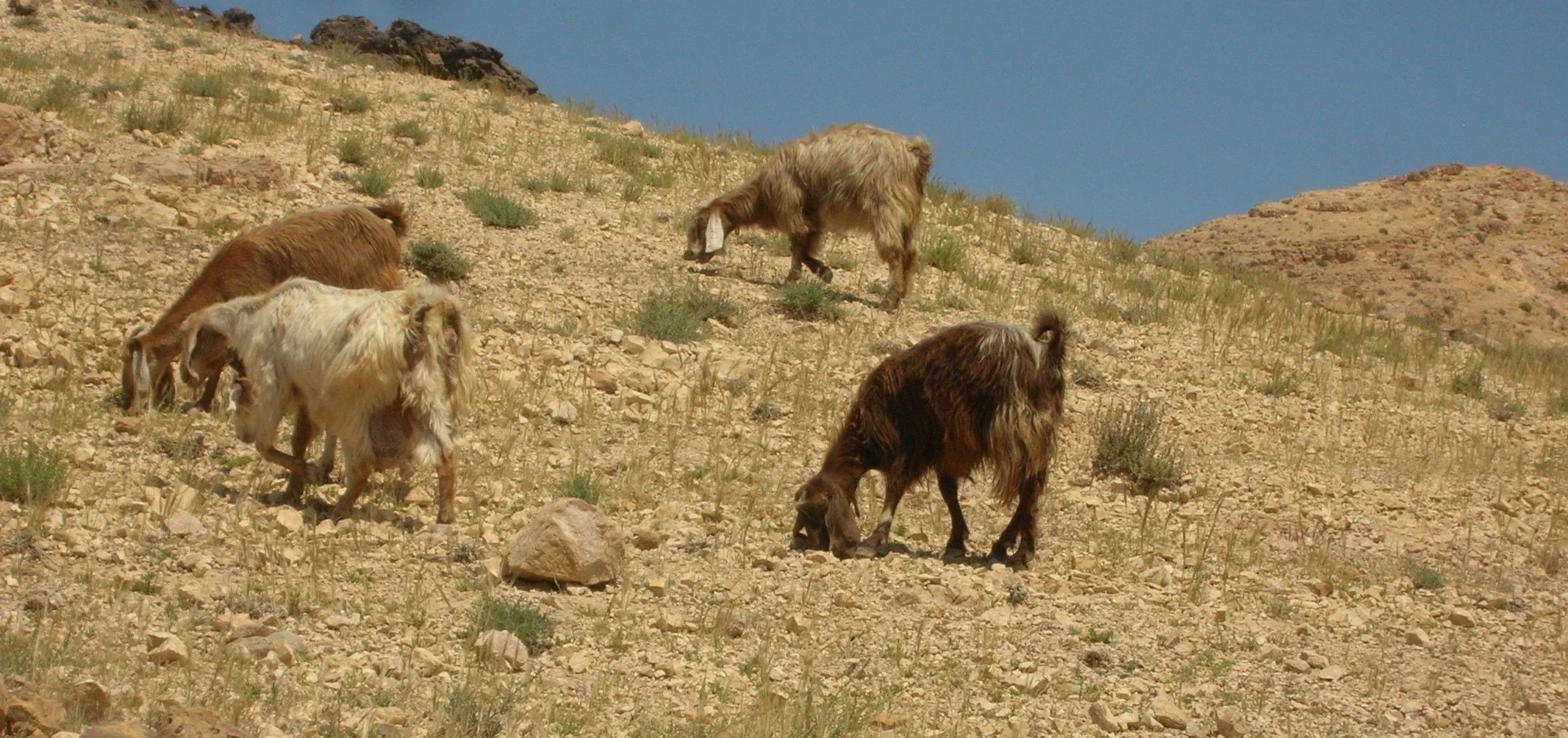
It’s worth asking the same question about the early history of southeast Arabia. As herds of domesticated goats and sheep grew, they grazed down the grasses and shrubs. Growing communities also needed more and more firewood, and with little to import, they cut native trees. Over time, that pressure may have helped turn savanna and shrubland into desert.
Climate was the bigger force. The monsoon rains that had made Arabia green in the early Holocene retreated over thousands of years, and the region dried out whatever people did. The debate is over how much humans sped it up. In southern Jordan, one study found signs of overgrazing from around 5,600 years ago, at a time when the climate was actually wetter, which points the finger at the herds. In Arabia, the evidence suggests people were mostly adapting to a drying climate, though their herds and fires could only have made things worse locally.
What gives me hope is that the damage can be undone. Projects in Jordan, Israel, Saudi Arabia and China, including Inner Mongolia, have shown promise in reversing desertification. Bringing back grasses and shrubs has helped the land hold water again. The overlooked part is the roots: they guide rainwater down into the soil, where it soaks in and refills the aquifers.
Without that plant cover, rain runs off in flash floods that strip the topsoil, robbing the land of its fertility and leaving it even less able to hold moisture. In dry places that depend on short, heavy bursts of rain, protecting the plants that keep water underground is essential. Otherwise each dry spell wipes out the land’s potential to turn green again, and the desert feeds on itself.
Sources:
(1) D. O. Henry et al., “Blame it on the goats? Desertification in the Near East during the Holocene,” The Holocene 27, no. 5 (2017).
(2) G. Barker, “A tale of two deserts: contrasting desertification histories on Rome’s desert frontiers,” World Archaeology 33, no. 3 (2002).
(3) C. E. Cordova, “The degradation of the ancient Near Eastern environment,” in A Companion to the Ancient Near East (Hoboken, 2020).
(4) M. D. Petraglia et al., “Human responses to climate and ecosystem change in ancient Arabia,” Proceedings of the National Academy of Sciences 117, no. 15 (2020).
(5) A. A. Abahussain et al., “Desertification in the Arab region: analysis of current status and trends,” Journal of Arid Environments 51, no. 4 (2002).
(6) G. R. Oñatibia et al., “Aridity exacerbates grazing-induced rangeland degradation: a population approach for dominant grasses,” Journal of Applied Ecology 57, no. 10 (2020).
(7) H. E. Dregne, “Desertification of arid lands,” in Physics of Desertification (Dordrecht, 1986).
(8) H. J. Geist and E. F. Lambin, “Dynamic causal patterns of desertification,” BioScience 54, no. 9 (2004).
(9) Photo: A Bedouin goat herd in the Negev desert. brewbooks, CC BY-SA 2.0, via Wikimedia Commons (2007).
