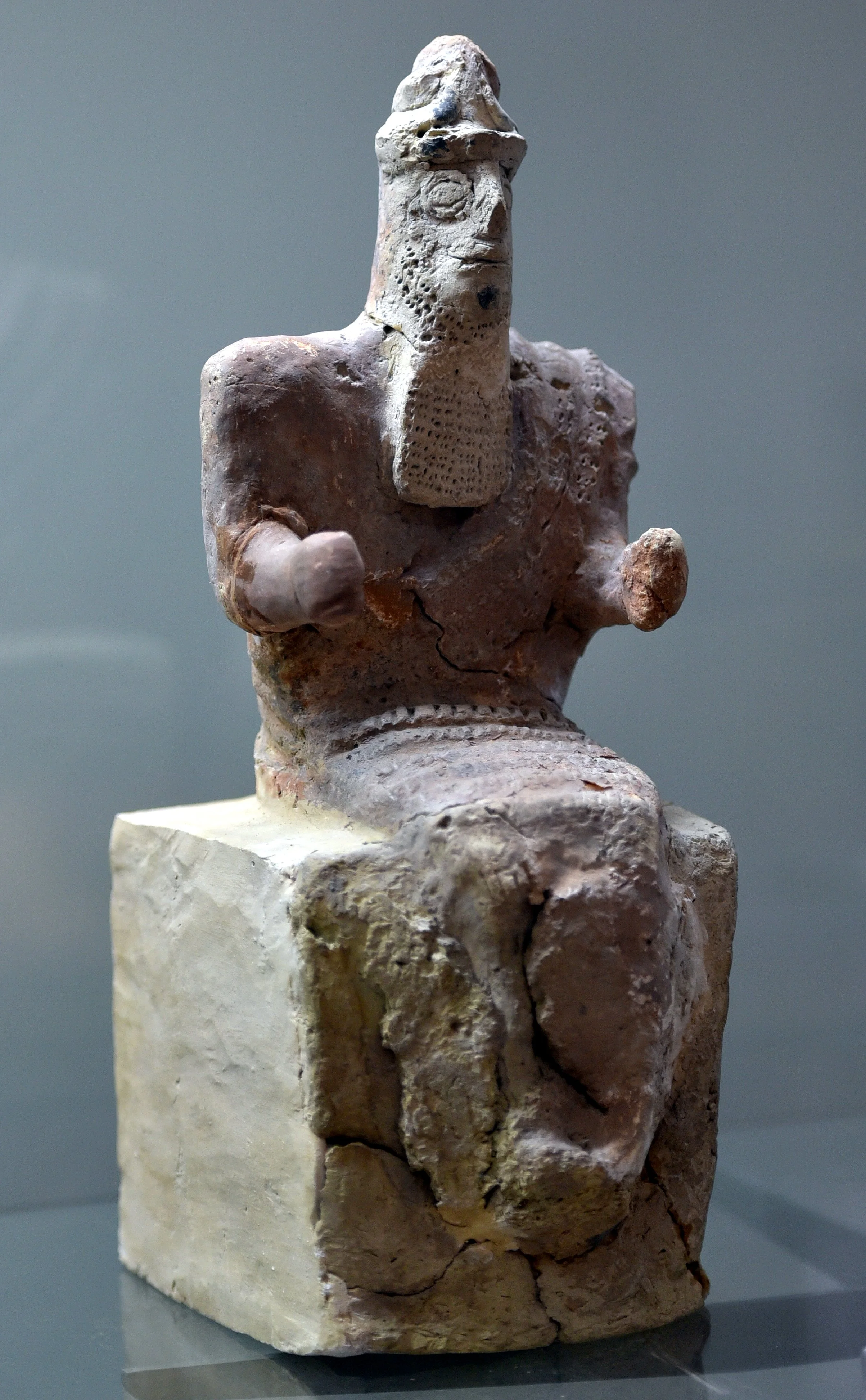
Long before Zeus, there was Enlil. His name is usually read as “Lord Wind” or “Lord Air”, and for much of the third millennium BC he was the most powerful god in Sumer.
His home was the Ekur, the “Mountain House”, in the city of Nippur. Nippur was never a great military power, but it did not need to be. A king who wanted his rule taken seriously had to win Enlil’s blessing there, and kings from all over Mesopotamia sent offerings and rebuilt his temple to prove it.
The myths remember him as a hard boss. Enlil holds the Tablet of Destinies, the source of his authority. In the Babylonian epic of Atrahasis, he is kept awake by the noise of the multiplying humans and tries to get rid of them, first with plague, then drought, and finally a flood. His rival, Enki, quietly warns one man to build a boat.
It is one of the oldest flood stories we have, written down around 1700 BC. And it travelled. The same story resurfaces in the Epic of Gilgamesh and, much later, as the flood of Noah in the Hebrew Bible, the Christian Bible and the Quran.
The flood hero changes his name as the story travels: Ziusudra in Sumerian, Atrahasis in the Babylonian epic, and Utnapishtim in the Epic of Gilgamesh, where he tells the whole story to Gilgamesh himself. But in every version, it is Enlil who wants humanity gone, and Enki who saves it.
Enlil’s power rested on the Tablet of Destinies, and another myth shows how fragile that was. In the Epic of Anzu, the lion-headed eagle Anzu steals the tablet while Enlil is bathing, and the gods are thrown into panic. None of them dares to face the bird until Ninurta, Enlil’s son, hunts it down and brings the tablet home.
Gods, like kings, can be replaced. As Babylon grew powerful in the second millennium BC, its scribes raised their city’s god, Marduk, to the top of the pantheon. In the Babylonian creation epic, the Enuma Elish, Marduk defeats the sea monster Tiamat, takes the Tablet of Destinies, and is honoured with fifty names, one of them given to him by Enlil himself. Enlil was not forgotten, though: Nippur and his temple there remained sacred for centuries.
It has always fascinated me how myths move between peoples and faiths. That a story first told in Mesopotamia ended up in the holy books of three religions shows how powerful these tales are. Even in antiquity they passed from people to people, and they have become part of the DNA of our modern heritage.
There is something almost comic about Enlil sending a flood simply because humans were too loud and kept him from sleeping. And yet the story has survived to this day. Even Louis XV of France is remembered for the line “Après moi, le déluge” (“After me, the flood”).
Sources:
(1) J. Black and A. Green, Gods, Demons and Symbols of Ancient Mesopotamia (London, 1992).
(2) S. Dalley, Myths from Mesopotamia (Oxford, 1989).
(3) G. Williams, Jesus Christ and Pagan Mythology: A Critical Analysis of Claims Regarding Jesus as a Copy of Pagan Gods.
(4) E. Noort, “The stories of the great flood: notes on Gen 6:5–9:17 in its context of the ancient Near East,” in Interpretations of the Flood, ed. F. García Martínez and G. P. Luttikhuizen (Leiden, 1999).
(5) N. Cohn, Noah’s Flood: The Genesis Story in Western Thought (New Haven, 1996).
(6) R. E. Simoons-Vermeer, “The Mesopotamian floodstories: a comparison and interpretation,” Numen 21, no. 1 (1974).
(7) D. L. Petersen, “The Yahwist on the flood,” Vetus Testamentum 26, no. 4 (1976).
(8) W. L. Moran, “Atrahasis: the Babylonian story of the flood,” Biblica 52, no. 1 (1971).
(9) Photo: Baked clay figure of Enlil seated on his throne, from Nippur, 1800–1600 BC. Iraq Museum, Baghdad. Osama Shukir Muhammed Amin, CC BY-SA, via Wikimedia Commons.
